Showing posts with label Project. Show all posts

Saturday, 21 January 2012

Exercise 20: Busy traffic

This is the final project that I had to finish for People & Place. I had taken some photos in the train/bus station a few months ago for this but was not happy with them. So today I went to the local farmers market which I know is a busy place, and set up my tripod, camera and variable neutral density filter.

I stayed pretty much in one place, the corner of the market, and changed my view from there. I have been before to the market so I knew that this was a good spot to catch the crowds and also people lining up to pay or peruse goods. I chose to use my variable neutral density filter to enable me to get multi-second exposures which I thought would show the movement of the people nicely. It was also important to have some people 'still' in the image otherwise it was all ghostly people moving past. I have put 6 shots below, 3 from each rough viewpoint which show the movement of the crowd around the market.

Photo 1: 1/8 sec


Photo 2: 2 sec


Photo 3: 6 sec


Photo 4: 4 sec


Photo 5: 2 sec


Photo 6: 3 sec


I think these photos show the movement and flow of people, and they are interesting and colourful at the same time. I think this technique (previously I've only used neutral density filters to slow shutter speeds in landscape work) is a good one for showing the flow of people in broad daylight. Obviously a tripod is essential, and a cable release helps to stop any camera shake also.

Monday, 21 November 2011

Exercise 22: Adjusting the balance between person and space

This exercise called for varying the balance between one person and the space they are in, keeping the general viewpoint and composition the same. This seemed to me to be a challenge, because surely, if we keep the viewpoint and composition the same, then the image will be the same! So I had to have a think. I have chosen to photograph my husband as we relaxed by the river on a rare child-free evening last week. The time of day was great for photography - early evening just before sunset, so the light was warm and soft and low angle. I set my WB on manual too, using a slightly warmed Kelvin to keep the nice warm light present in my image.

I chose a moderately low angle first, kneeling on the ground, and using a large aperture to have blurry grass in the foreground:


Next I got down even lower and got some building in the background, dark and providing a nice upper frame to the image, balancing the bright green grass in the foreground:


Then I changed my angle slightly to include more of the wall and less of the grass:


Finally I stood up and shot down on him, giving a totally different perspective:


The result is four quite different images! I think the second image is my favourite out of the set. The view is complimentary, the DOF suitably shallow and the background and foreground are nicely balanced. Another excellent exercise in forcing me to look for many images in one setting.

Tuesday, 25 October 2011

Exercise 23: Selective processing and prominence

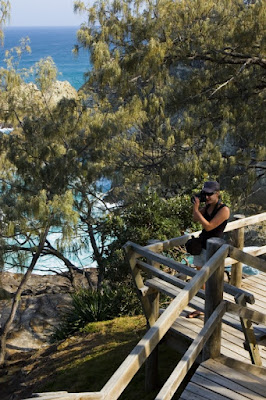
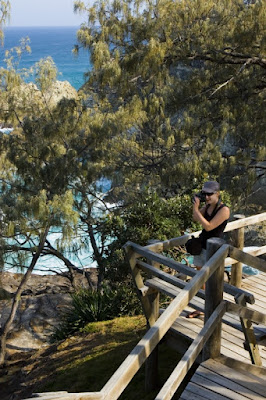
The aim of this exercise is to use simple post-production techniques to either emphasise a figure or make it less prominent in a setting. I have chosen two photos taken recently at North Stradbroke Island. I was hoping to use this location for Assignment 4 but I don't have a sufficient number of high quality images so won't be using it for my subject unless I can get back in the next month or two.  It is a beautiful location - these two photos were taken at the Gorge Walk, in Point Lookout. North Stradbroke Island is very easy to get to from Brisbane and is a popular location for all sorts of beach related activities and also for wildlife spotting.

Photo 1. First the image as it came out of the raw process. I have increased saturation and the photo shows a nice view through trees to water in the distance with a photographer friend posing for me on a wooden walkway structure. I have only adjusted exposure etc for the whole image in this photograph.


Photo 2. This shows the image as before but this time I have gently dodged over my friends face and upper body using the soft light technique in photoshop. She now stands out better from the trees and is thus more prominent in the photograph.


Photo 3. This image has a very prominent woman in the foreground, in her brightly coloured dress, again taken directly from the raw process, only with exposure/saturation edits to the whole image.


Photo 4. I have used the same technique as before, gently burning in the woman and her bright dress to slightly darken her. She is now less prominent than Photo 3, and in fact I think the photograph as a whole is more successful. She actually looks more tanned in this image too which often would be appreciated in a portrait. The effect is quite subtle on the small images actually...


I have not done this sort of processing before (in fact I just learnt today how to do it for this exercise!) I think it will be very useful to know how to do this kind of minor dodge/burn which is subtle and yet quite effective. I actually think the two edited photographs are improved from the selective processing that I have applied.

Other options for selective processing would be to blur either the fore or background to emphasise the person, but that was not suitable in these cases and in fact I don't yet know how to do it. I'll investigate further and perhaps add another image to this exercise later on.

Monday, 26 September 2011

Exercise 16: Exploring function... revisted

When I first did this exercise (see post here), I commented that I would like to revisit it using another space. Since I took myself off to the hairdresser last week to take photos specifically exploring function, I thought it would be good to post here under a revision of Exercise 16. I've already posted about the hair salon so I won't go into too much more detail about the process, but will make some comments as to how it relates to Exercise 16.

Firstly, the intention of use is clear - it is a place for getting your hair cut... also, vitally important is that the client must feel good about themselves, preferably beautiful and pampered. It also has to be practical, well lit, easy to move around and spacious. In this case all boxes are ticked.

Who uses it? The hairdresser and clients. I only considered the front area, but it is very pleasant to be in, with large windows and lots of lighting and mirrors which emphasizes the space. Most of the walls are white except for the back 'feature wall' which is black.

What is it used for? Discussed already - cutting hair/ pamper.

Now for my ...carefully considered photograph... well I have already posted the best 5 taken on the day, but in terms of function, I think an overview photograph is the best for showing how the space is used as I have discussed above.

Tuesday, 20 September 2011

Exercise 21: Making figures anomyous

The aim of this exercise was to understand and utilize ways of including people/person in a photograph of a place while deliberately making them unrecognizable. In some of the following photographs I have succeeded in this, but in others I have zoomed in too much on the person so the photograph is more about them than the place. I have included them anyway as it is all part of the learning process.

Photo 1. Reflection in a painting at GOMA. Perhaps too much about the fun nature of the image rather than a space per se.


Photo 2. Small and many (not that many...) Good balance between the children and tables.


Photo 3. Partially obscured. An effective and interesting photograph, but not really about a space, more focussed on the woman - I should have stepped back and included her in her environment more.


Photo 4. Cyclist in silhouette. An effective photograph of a building, with the cyclist in silhouette giving some human interest.


Photo 5. Couple in silhouette, sunset at Noosa. Another effective photograph of a stunning sunset complete with moon finished off with the inclusion of the (small) couple in silhouette. 


Photo 6. Red wall, advertising sign with people. About the place (under a bridge), with the inclusion of people slightly blurred against the bright wall.


Photo 7. Perth convention centre - a cleaner and man shown from behind add interest to the foyer of the large convention centre.


Photo 8. One from the archive - Munich showing small people which emphasise the scale of the gardens.


Photo 9. Another from the archive - this time Dubrovnik, old buildings with a very blurred person who almost looks ghost-like in this photo...


So not all were a success but a good collection of examples showing how people can be included but with less emphasis. I need to step back a bit more sometimes to capture more about the space than the people. With projects like this I'm so glad I have my super dooper point and shoot (Canon Powershot S95), it's so useful to have it with me all the time!

Update. Exercise 18

I have taken a few more photos for Exercise 18: How space changes with light. The local netball courts provided a good opportunity for some interesting lines and shapes, and I decided to photograph them both in the early evening and in the middle of the day, with obvious large differences in outcome!

Photo 1: Time of photo 5:51pm. ISO 160, f/4.5, 1/3s, -5/3 EV


Photo 2: Time of photo 12 midday. ISO 100, f/6.3, 1/400s, -4/3 EV


I slightly prefer the first photo taken at dusk. The purple sky and small pools of water reflecting the sky are particularly successful I think. In both images the wide angle view emphasises the large space, and the lights give the vertical space some definition. The white lines painted on the ground lead the eye through the image.

Speaking of leading lines through an image, check out this awesome photo taken in New York by Stephen Doyle and photographed by Stephen Wilkes, he has installed tape on the floor/walls and then photographed kids over the top. The effect is incredible.


Exercise 19: A single figure small

The task for this exercise was to photograph '... a place which is mostly free of people, yet with an occasional figure passing through it'. And I guess it should be somewhat interesting too?

I went walking at Southbank for a short while on the weekend and took a couple of photos. The first is a someone standard photograph of the front of the train station, with someone exiting the frame on the right. Although convention is to have people walking into the frame, I thought it was more interesting in some ways having him exit the frame, i.e. just arrived on a train and leaving the train station area. Not sure. Anyway, he is dynamically placed close to the edge of the frame. Bright blue sky in the background (matching my person's outfit, though obviously I didn't plan for that!) and lovely brick building with a yellow post as accent in the foreground.


The second photo is of one of the fancy hotels in the area, the Mantra. I had not spotted the pool before, and I think it fits in nicely with this exercise which was to see if you (the viewer) can have a delayed reaction in noticing the figure. In this case it is not the scale that is unusual but the presence of the figure indicates that actually there is a pool overlooking the road! I like the strange relationship of the traffic lights superimposed on the building and man, and also like the bold oranges and blues in this image. The strong geometric lines are effective also (though some may say might work better on a diagonal?)


The inclusion of people as small accents in these two photos _definately_ make for more interesting images of the buildings and this is a technique I will continue to explore with my photo making.

Thursday, 15 September 2011

Exercise 15: Public space, public activity

This exercise is actually from chapter 2, however I only finished taking photos last weekend for it. I actually started it a year ago in Edinburgh with some photos take in the Princes St gardens one (rare) very sunny day, with everyone out sunbathing enjoying the warmth. Since moving to Brisbane where it is warm almost all year round, I have noticed a real difference in attitude - I have not once seen someone sunbathing on the lawn here, as opposed to Edinburgh where as soon as the sun is out and it's somewhat warm there are people lying on the lawn with bellies exposed. Quite a contrast. So I wanted to photograph a public area here in Brisbane, the local farmers market has an adjacent lawn patch with a few stalls around where people congregate on a Sunday morning after they have done their grocery shopping, sit back with a cup of chai and enjoy the atmosphere.

The first 8 photos show the way people are using the space in Princes St Gardens, Edinburgh.


From Exercise_15


From Exercise_15


From Exercise_15


From Exercise_15


From Exercise_15


From Exercise_15


From Exercise_15


From Exercise_15


The second set of 8 show a variety of activity taking place at Northey St Farm on a sunny Sunday.


From Exercise_15


From Exercise_15


From Exercise_15


From Exercise_15


From Exercise_15


From Exercise_15


From Exercise_15


From Exercise_15


I really like the contrast between these two sets of images. In each of them there are some solitary people enjoying time on their own, and also small groups of people chatting, interacting with children, eating and drinking or relaxing in their own way. Capturing different activities gives an overall picture of the area which can be more telling than a single photograph. The strong contrasting sunlight is present in both sets, despite them being taken on opposite sides of the world! I like the strong dark shade patches in some of the first set of photographs in particular.

Thursday, 8 September 2011

Exercise 18: How space changes with light

The aim of this exercise was to understand better how important good light is to a successful photograph. I have seen this before during my TAOP studies, but this time the exercise is more directed towards _space_ and perhaps buildings to a lesser extent. I undertook this exercise while I was working on Assignment 3 Buildings in Use so there is some overlap between the two.

I have chosen two locations for this exercise, one is an overpass near my place of work.  I have photographed in full sunlight during the middle of the day where strong shadows are seen cutting across the overpass and captured a cyclist - he looks almost sandwiched between the roof and strongly patterned floor. All the lines converge and add to this image.

From Exercise_18

I chose a different angle for the second photograph, choosing this because of the lovely sky behind. The very low angle of view and framing of the star-like structure in front of the cloud and directly over the cyclist works very effectively in this image. A little motion blur does not detract from the image. I underexposed by a full stop to keep the slightly dark feel of the photo in keeping with the time of day.

From Exercise_18

For the second location I have used the bridge that I am including in Assignment 3, half built as part of Brisbane's Airlink project. The changes in light I saw at this location were very dramatic and reminiscent of the light in Scotland (though much warmer of course :). I was out taking photos making use of the slightly overcast day, and was not terribly happy with the results (see first image). Then suddenly the sun broke through the clouds and there was brilliant light on my subject and the contrast between it and the dark clouds and blue sky was so dramatic it was amazing. These two photos are taken in basically the same location but very strongly show the difference between average light and excellent light. Worth waiting for.

From Exercise_18
From Exercise_18

OK so I continue to learn the value of good light whenever I am lucky enough to encounter it... Unfortunately I don't always have the time (... and patience) to wait for good light and need to just get the shots and go. Good to continue learning about the value of light, as we are all just painters of light...

Exercise 17: The Users Point of View

The aim of this exercise was to choose spaces designed for a particular activity that is taken from a specific distinctive position and to photograph from that point of view. I had a number of ideas for this exercise but it has been a while in the making and I'm not sure it's yet complete... It was slightly difficult to think of appropriate viewpoints that could be captured in public places without looking strange, though perhaps I should give up on that idea and just accept that I do stand out sometimes with the camera. I have used my point & shoot (Canon Powershot S95) for these examples as it is generally easier to carry around with me and use discreetly.

My first photo idea was to photograph not the car that I drive in (because I hardly ever do) but instead the bike that I ride to and from work. I chose a relatively attractive background and then framed the image to show my view of the handlebars and bike path beyond, just near the Roma St Parklands in Brisbane. As a photograph there are good diagonals in the photo and the lighting interesting.

From Exercise_17
My second photo idea was to photograph the beauty salon that I go to, from the relaxation bed. The view is not particularly interesting and I'm not sure I have conveyed the users point of view particularly well in my photograph.

From Exercise_17
Another idea that I had was to photograph my son on the see-saw. I am sitting on one end and him on the other, so it literally is a users point of view, but it doesn't really fit the brief as it's not a 'space' per se. Nonetheless it conveys something of a users point of view.

From Exercise_17
The final idea was photographed in a cottage, with a view over a table with nice scenery beyond. I have had some challenges in executing the lighting for this image (I didn't have my flash with me so only had on-camera flash and this did not do a very good job of lighting the scene in the diminshing natural light).

From Exercise_17

I feel like I have learnt a lot about _trying_ to see from the users point of view, but I'm yet to successfully capture this with my camera. It's a good lesson though, and now when I am out and about I'm looking for 'users point of view' examples and trying to capture them. I guess that's the whole point of doing these exercises!